
 EN
EN
 AR
AR
 BG
BG
 HR
HR
 NL
NL
 FR
FR
 DE
DE
 EL
EL
 HI
HI
 IT
IT
 KO
KO
 PL
PL
 PT
PT
 RO
RO
 RU
RU
 ES
ES
 TL
TL
 IW
IW
 ID
ID
 LV
LV
 LT
LT
 SR
SR
 SL
SL
 UK
UK
 VI
VI
 HU
HU
 MT
MT
 TH
TH
 TR
TR
 AF
AF
 MK
MK
 HY
HY
 AZ
AZ
 UR
UR
 BN
BN
 LA
LA
 NE
NE
 MY
MY
 KK
KK
 UZ
UZ
10 things you must know before purchasing a WPC door panel extruder
2026
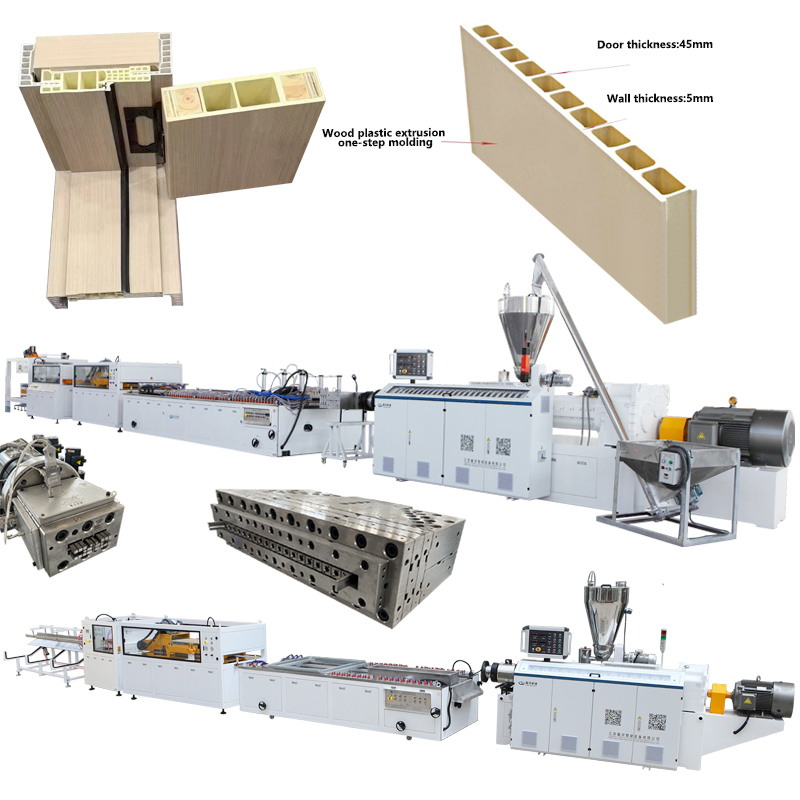
1.Equipment capacity must match production scale. WPC door panel extruders have a wide capacity range, from 100kg/h to 1000kg/h. The width and thickness of the door panel determine the equipment capacity. For widths below 300mm, a 180–300kg/h model is recommended (e.g., Xinhe SJSZ65/132, 37kW). For widths above 900mm, a model with a capacity of 800kg/h or higher should be selected (e.g., Xinhe SJSZ92/188, 110kW). Insufficient capacity will restrict order delivery and may also exceed machine capacity, leading to reduced machine lifespan; excessive capacity results in wasted capital and energy.
2.The screw structure must be a twin-screw extruder. WPC material has poor flowability and high heat sensitivity. Single-screw extruders easily lead to uneven plasticization and rough surfaces; a conical twin-screw structure must be selected. The industry recommends models like the SJSZ92/188 (such as Xinhe models) to ensure sufficient melting and uniform mixing.
3.Temperature control accuracy must reach ±1°C; ceramic or cast aluminum heating methods are preferred. PVC and wood flour are both heat-sensitive materials; temperature fluctuations >5°C will cause color difference, carbonization, or decreased strength. The equipment should have a segmented independent temperature control system with an accuracy of ±1°C (laboratory-grade standard). Ceramic heating coils (fast thermal response, long lifespan) or cast aluminum heaters (uniform heat dissipation) are recommended to avoid the aging risks of traditional resistance wires.
4.The control system must be fully automatic with PLC, supporting parameter memory and fault self-diagnosis. Manual operation is prone to errors; an intelligent control system with PLC and touchscreen should be selected, supporting one-button start/stop, process parameter storage, operating data recording, and fault code prompts (such as Xinhe models). Machines with frequent operations, such as cutting machines, must use PLC control, as manual operation can easily lead to production instability. PLC lowers the operating threshold and improves stability.
5.The cooling system needs segmented water cooling + air cooling to avoid temperature differences >5°C. Improper cooling is a major cause of door panel warping and internal stress cracking. The equipment should be equipped with multi-stage cooling brackets, with water cooling for shaping at the front and air cooling for slow descent at the rear, ensuring a temperature difference of ≤5°C between different areas of the product. The water channel should be ≤15mm from the product surface to avoid a heat transfer efficiency reduction of more than 40%.
6.Mold matching is crucial: One-out-of-one vs. one-out-of-two, do not confuse. The mold determines the finished product specifications. Common door panel sizes are 735×40mm, 955×40mm, etc. It is necessary to confirm whether the mold is one-out-of-one (single-piece molding) or one-out-of-two (two-piece parallel molding). If the mold does not match the product, the scrap rate will skyrocket. Some manufacturers offer free mold design support; be sure to confirm this before purchasing.
7.Prioritize full-service providers to ensure timely after-sales response. Door panel production requires high technical support, involving many processes from raw materials to finished products; stable, comprehensive technical services are essential.
8.Environmental certification is a mandatory requirement: Equipment must comply with REACH, RoHS, and CE standards. For export or high-end market procurement, the equipment must be equipped with VOC-free emissions, a central dust collection system (dust recovery rate ≥95%), and provide CE, RoHS, and REACH certification documents. Equipment that does not meet these standards will fail customs or customer factory inspections, posing compliance risks.
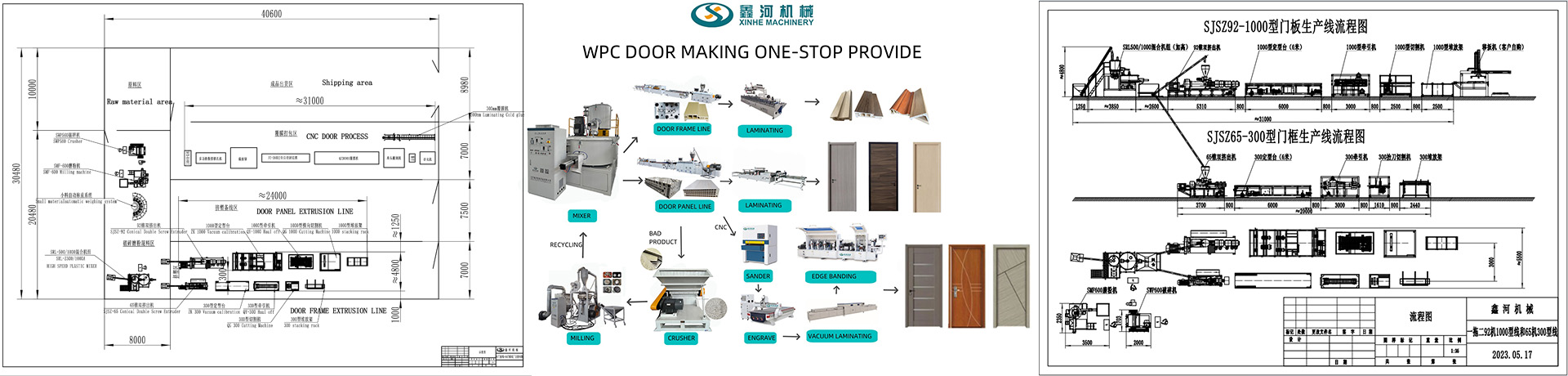
9.Integrated production line design is more important than individual machine performance. A high-performance extruder ≠ a successful production line. The entire line must include: a hot mixing + cold mixing system (to prevent wood dust moisture absorption), a vacuum shaping die (to control cross-sectional accuracy), servo traction + flying saw cutting (error ≤±1mm), and automatic palletizing. Modular design facilitates future upgrades, avoiding piecemeal assembly by "buying the main unit and buying spare parts." A visit to the Jiangsu Xinhe factory is recommended.
10.Price range and cost-effectiveness need rational evaluation; beware of "ultra-low price traps."